August 18, 2026
What's your AI translation actually costing you?
What you're probably missing about AI translation costs
You're using AI translation. You think it's saving money. But are you actually calculating all the costs? Most companies aren't.
Louis Mathieu, Chief of Staff at Powerling, asked something in July that I hear in inboxes every week: "Running multiple AI models in parallel obviously costs more than just one translation pipeline. How does this influence overall costs?"
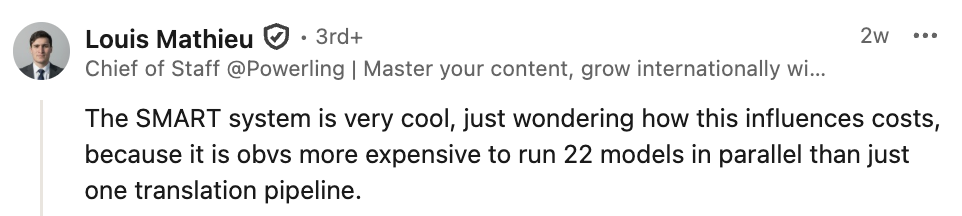
He's right that per-request cost goes up when you run multiple models. But here's what most people miss: the total cost of ownership goes down. And the gap widens as you scale.
If you're translating 10,000 documents per month with a single AI model, I'm going to walk through what you're actually spending.
The hidden costs of single-model AI translation
Single-model translation looks cost-efficient at first. You pick one AI model. It translates fast. You pay a fixed amount per request. Simple.
What you're not seeing is what happens after that single translation comes back.
Individual top-tier AI models carry a hallucination rate of 10 to 18 percent on translation tasks. That's not my opinion. That's what our internal benchmarks show, and it aligns with what every major AI vendor acknowledges about their own systems. A hallucination in translation means the model invented a detail, flattened an idiom, missed a legal term, or produced something subtly wrong enough that a human has to catch it.
At enterprise scale, this compounds fast. If you're translating 10,000 documents per month through a single AI model, that 10 to 18 percent error rate means 1,000 to 1,800 translations come back wrong enough to need rework.
Now add the downstream costs:
01. Retranslation cycles. Every failed translation has to be resubmitted, retranslated, and verified again. At 1,000 to 1,800 retranslations per month, your per-request cost just tripled or quadrupled.
02. QA overhead. Because you're using a single model, you have no verification signal. You need a human reviewer to read every translation and flag problems. At scale, that's a dedicated team.
03. Time cost. Rework takes time. Delayed translations mean delayed launches, delayed content releases, delayed market entry.
04. Compliance risk. In regulated industries (legal, medical, financial), errors aren't just expensive to fix. They're expensive to disclose.
Single-model translation is cheap on paper. It's expensive in practice.
How consensus reduces total cost of ownership
Consensus-based translation works differently. Instead of picking one model and hoping it's right, you run the same text through multiple independent AI models simultaneously and surface the version the majority agree on.
By default, MachineTranslation.com uses 22 models that prioritize LLM-based systems — models that accept context through prompting, such as tone, register, and domain instructions. These models are chosen because they're "steerable": you can instruct them to translate like a legal expert, a medical professional, or a marketing team, and they adapt their output accordingly.
Unlike fixed neural machine translation systems (such as Google Translate or DeepL, which don't accept added context), these LLMs bring semantic flexibility to consensus. But users aren't limited to the default set. If you need Google Translate or DeepL included in your comparison or consensus run, you can manually add them to your preferred models list.
This sounds like it should be slower and more expensive. It's not, because the models run in parallel. All default models execute at the same time. Your response time is dominated by the slowest single model, not the sum of all models. The user sees one result. The engineering that made it reliable happened underneath.
When you run 22 independent models on a translation and 20 of them agree on the same output, that agreement is itself a quality signal. You don't need a human reviewer for that translation. The majority consensus is the verification.
When 22 models disagree, or when a small minority diverges from the consensus, the system flags that divergence. That's the signal to send the translation to human review, not every translation, just the ones the models couldn't agree on.
Our internal testing found that users who relied on MachineTranslation.com's SMART consensus spent 24 percent less time fixing translation errors than users who tried to manually evaluate outputs from a single model. The consensus approach also reduced the human verification effort needed by 18 to 22 percent, because reviewers only had to assess the flagged disagreements, not every line.
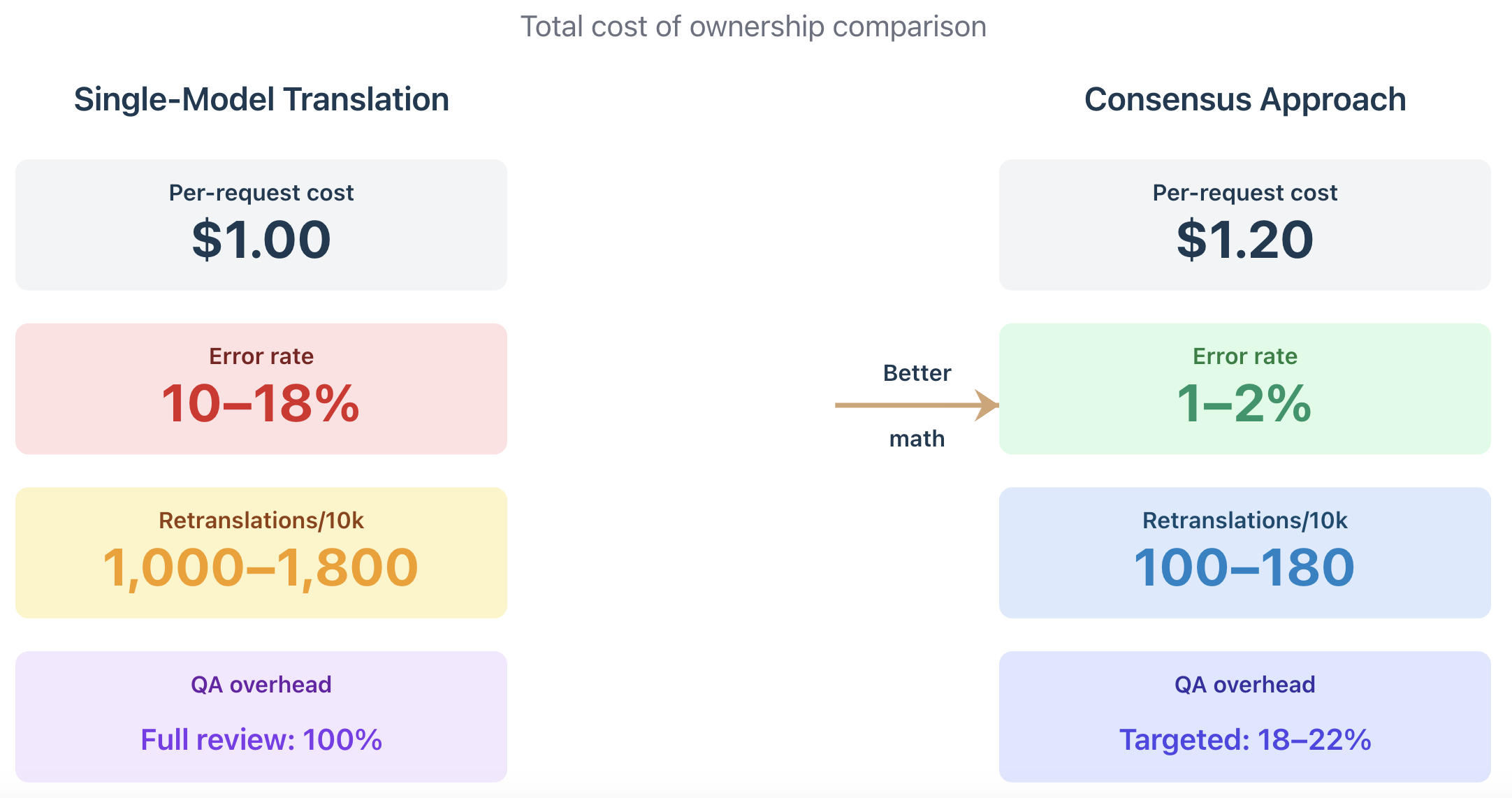
The math becomes clear: yes, the per-request cost is higher. But the downstream costs are dramatically lower.
Consensus vs. single-model: Error and cost data
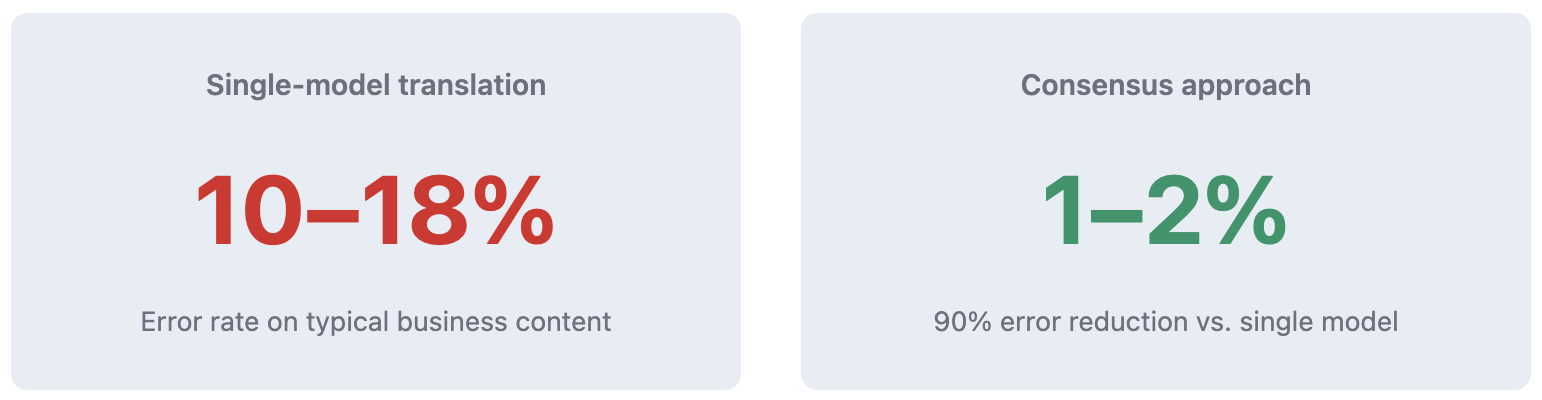
Here are the specific numbers from our benchmarks. Single-model translation shows error rates around 10 to 18 percent on typical business content. When consensus-based translation runs the same content through 22 independent models and reports the majority agreement, error rates drop to roughly 1 to 2 percent — a 90 percent reduction in errors.
Error rate breakdown
Think of it visually: on the left, a single AI model generates 10 to 18 errors per 100 translations (shown in red/orange). On the right, the same content run through 22-model consensus drops to 1 to 2 errors per 100 translations (shown in green). At 10,000 translations per month, that difference means the single-model approach produces 1,000 to 1,800 errors requiring rework, while the consensus approach produces 100 to 180 errors. The 90 percent figure isn't marketing language. That's what we found when we ran independent testing of our SMART mechanism. Multiple independent models checking each other catch problems a single model misses silently.
Domain-specific error reduction
The improvement varies by content type, and stakes are highest in regulated verticals. In regulated domains (legal, medical, compliance), the error-reduction benefit of consensus is more pronounced, because every error carries downstream cost. Our testing found error rates fell 19 percent in regulated-industry translation tasks when using consensus versus a single AI model.
The voting mechanism that powers consensus translation is well-established in the research literature. Translated.com's research on consensus translation documents how voting and probability-based approaches orchestrate agreement among diverse models, each with its own strengths and weaknesses. This ensemble approach is particularly effective in regulated industries because the voting mechanism itself becomes an error-detection signal: when models diverge, it flags potential issues before they reach production.
In mixed business and legal content (contracts, terms of service, compliance documents), MachineTranslation.com's consensus approach reduced what we call "error-style drift" compared to single-model outputs. "Error-style drift" means the kind of mistake that looks minor in one sentence but accumulates across a document, shifting tone or legal weight. Consensus catches those subtle drifts because the model pool is forced to agree on terminology and phrasing.
Human verification burden reduction
Because consensus surfaces disagreement, human reviewers only assess the translations where models diverged. This reduced the verification effort needed to check translations for errors. More importantly, it changed what reviewers had to do. Instead of reading every translation to look for errors, they could focus on the specific terms or phrases where the model pool split.
The total cost curve
The cost breakdown looks like this: the table below shows three rows comparing single-model and consensus approaches.
| Cost Component | Single-model approach | Consensus approach |
|---|---|---|
| Per-request cost | X | Slightly higher than X |
| Error rate | 10-18% | 90% reduction (roughly 1-2%) |
| Retranslations per 10,000 | 1,000 to 1,800 | 100 to 180 |
| QA overhead | Full human review on every translation | Targeted review only on flagged disagreements (18-22% of volume) |
| Total monthly cost | (10,000 + retranslations) × X + QA team hours | (10,000 + retranslations) × (X + premium) + reduced QA team hours |
The per-request cost is higher. The total cost is lower. The gap widens as you scale.
Why the translation industry gets consensus costs wrong
Most companies evaluate translation cost per request, not cost per successful translation.
A single-model system costs $1 per translation. Consensus costs $1.20 per translation. If you're looking at a spreadsheet, the first one wins. You're not looking at a spreadsheet when you're 500 errors deep in retranslation backlog.
The second mistake is treating quality and cost as separate problems. They're not. Lower error rates reduce retranslation volume, QA overhead, and time-to-launch. That's not quality marketing. That's cost accounting.
The third mistake is ignoring the cost of uncertainty. With a single model, you have no way to know whether a translation is right unless you read the target language fluently. That uncertainty forces you to review everything. With consensus, you only review the uncertain parts. Certainty is cheaper.
Consensus-based translation is the most cost-efficient approach per quality outcome, not despite the higher per-request cost. The industry hasn't built a mental model for that yet.
Single-model translation is cheap per request and expensive to operate at scale.
Consensus-based translation is expensive per request and cheap to operate at scale.
When you factor in retranslation cycles, QA overhead, and the cost of uncertainty, the total cost of ownership favors consensus by a significant margin.
That's not a belief. That's what the data shows.
How consensus works and how to set it up
To understand the mechanism behind MachineTranslation.com's consensus approach in technical detail, read how it works here. That post explains the voting algorithm, how disagreement is flagged, and why majority agreement reduces errors.
If you're ready to access consensus translation from your existing AI tools, check this guide on how to set up MachineTranslation.com's MCP Connector to bring SMART consensus into Claude, ChatGPT, and other AI assistants. The setup takes less than a minute, and every translation runs through the full 22-model consensus automatically.
FAQs
1. Does running 22 models mean slower translation?
No. Parallel execution means all 22 models run simultaneously, not in sequence. Response time is dominated by the slowest single model, not by summing all 22. MachineTranslation.com's consensus approach runs every translation through 22 models without adding latency compared to a single model.
2. Is consensus-based translation only for enterprise?
Consensus is available on any paid MachineTranslation.com plan, including our 24-hour pass and month-long Pro subscription. View all paid plans here. Cost-efficiency scales with volume. A small team translating 50 documents a month saves less in absolute dollars than an enterprise translating 50,000 per month. The percentage savings are the same.
3. How much can we actually save?
It depends on your baseline error tolerance and QA overhead. A team doing basic translations with low accuracy requirements sees modest savings. A team in regulated industries (legal, medical, compliance) with strict verification requirements sees dramatic savings, because every error carries downstream costs. We can model your specific case if you share usage patterns.
4. Does consensus require more setup?
No. MachineTranslation.com's SMART consensus is the default translation method for all users. You don't configure it or turn it on. You translate, and consensus runs automatically. The only setup required is choosing which plan fits your volume and use case.
5. What if consensus gets it wrong?
Consensus doesn't eliminate errors. It makes errors more visible. When 20 models agree and 2 diverge, the system flags that as a signal to review. When all 22 models agree but still miss something, the system has no way to know. But that scenario (total model failure) is rarer than partial failures (some models get it right, some don't). Consensus catches partial failures; nothing catches total failures except domain expertise.
6. How do error rates vary by language pair?
Consensus improvement is more pronounced on high-resource language pairs (English to Spanish, English to French) where the model pool is mature. On low-resource languages (English to Twi, English to Tamazight), error rates are higher for all models, but consensus still reduces errors by a similar percentage. The absolute error rate is higher, but the consensus gain is consistent.
7. Can I add other models like Google Translate or DeepL to my consensus run?
Yes. By default, MachineTranslation.com's SMART uses several LLM-based models that accept context through prompting. If you want to include fixed NMT systems like Google Translate or DeepL in your comparison or consensus mechanism, you can manually add them to your preferred models list on any paid plan.

By Rachelle Garcia
Connect on LinkedInRachelle leads product and AI at Tomedes, where she runs the experiments that turn internal data into better translation experiences. She writes about what actually happens when you build AI products such as MachineTranslation.com — the numbers, the surprises, and the parts that don't go to plan.
Share:


