October 6, 2026
How do you say please, thank you and sorry in other languages?
If you work with customers, partners or suppliers abroad, you type the same few phrases again and again: please, thank you, sorry, good morning, best regards. You paste each one into a translator and get a word back. The word is usually correct.
The catch is that many languages give you two or three correct words for the same English phrase. Each one says something different about how you see the person you are writing to. Pick the wrong one and the message still makes sense. It sounds a little off to the person reading it.
This guide covers 28 phrase and language pairs that we have run through MachineTranslation.com. Each one links to a live page where you can see where the AI models agreed and where they split. You also get the method I use to choose between versions, so you can do the same for phrases that are not on the list.
Key takeaways
- French, German and Spanish each have a formal and an informal way to say “you,” so polite phrases such as “please” and “you’re welcome” change with the reader.
- German uses “bitte” for both “please” and “you’re welcome,” and Japanese has no single word for “please,” so a one-word lookup often hides a choice.
- In a MachineTranslation.com model comparison test of a message to a CEO, most models answered in formal Japanese and one answered in casual plain form, and the comparison view showed the difference.
- In MachineTranslation.com’s own testing on English to German translation, about 14% of engines leaned informal when a formal business sentence used a plain “you.”
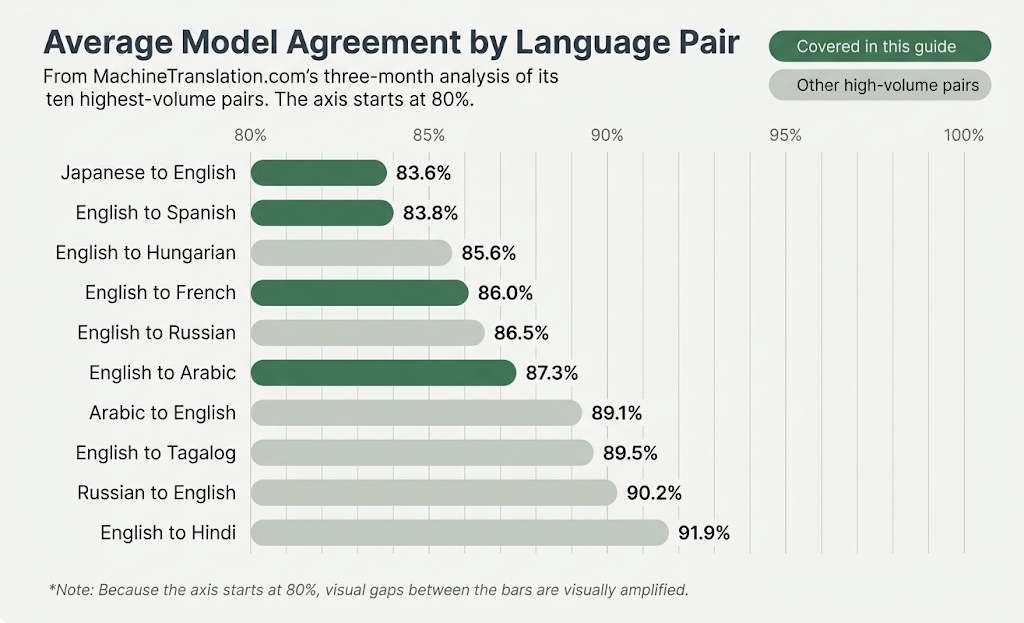
- Across the ten highest-volume language pairs on MachineTranslation.com, average model agreement ranged from 83.6% to 91.9%, and English to Spanish landed near the bottom.
How do you pick the right version of a phrase?
Start with the reader. French, German and Spanish each have a formal and an informal way to say “you,” and polite phrases change with that choice. Decide the relationship first, then pick the phrase from there. This is the order I follow.
Linguists call this split the T–V distinction. French has tu and vous, German has du and Sie, and Spanish has tú and usted. English has no everyday equivalent, so an English sentence rarely tells a translator which one to use.
- Decide who the reader is. A client, a new contact or a senior person gets the formal version. A friend or a close teammate can get the informal one. When you are unsure, go formal.
- Decide whether the phrase will be spoken or written. Written business messages follow fixed patterns, especially in the closing line.
- Open the AI translator for your phrase and language pair. If the models agree, the phrase is stable. If they split, the phrase has more than one valid version and you need to choose.
- For anything customer-facing, ask a native speaker to confirm the register before you send it.
We covered the same pattern in ten other phrases in our earlier piece on common phrases that are harder to translate than they look. This guide goes wider, with six everyday phrases across French, German, Spanish, Japanese, Arabic and Korean.
How do you say please in other languages?
“Please” changes shape from language to language. French uses “s’il vous plaît” when formal and “s’il te plaît” when informal. German uses “bitte” for both. Spanish uses “por favor” in most settings. Japanese has no single word, so it uses “onegaishimasu” or “kudasai,” depending on the request.
None of these are hard words. The difficulty is that English gives you no clue about which version you need. “Please” looks the same whether you write it to your CEO or your cousin.
When a phrase is fixed, AI models handle it well. MachineTranslation.com’s model version testing used a standard business line, “Please confirm receipt of this document.” Translated into German, it returned the same or nearly the same output from every model tested, including the smallest ones in the comparison.
Japanese is the page worth opening first. “Onegaishimasu” asks for something, as in “the bill, please.” “Kudasai” follows a verb, as in “please wait.” A single-word lookup cannot tell you which one your sentence needs.
| Phrase | Language | Live page |
|---|---|---|
| Please | French | How do you say please in French |
| Please | German | How do you say please in German |
| Please | Spanish | How do you say please in Spanish |
| Please | Japanese | How do you say please in Japanese |
How do you say thank you and you’re welcome in other languages?
French says “merci” and German says “danke.” Arabic says “shukran,” and Japanese says “arigatou” with friends and “arigatou gozaimasu” in polite settings. The reply takes more care. French uses “de rien” in casual moments and “je vous en prie” in formal ones. German uses “bitte,” and Spanish uses “de nada.”
German is the tricky one for translators. English keeps “please” and “you’re welcome” as two separate words, while German uses “bitte” for both. The words around it decide which meaning applies, so a lone “bitte” needs context before anyone translates it.
Short polite phrases survive translation well. In MachineTranslation.com’s back translation test, a business phrase went from English to German and back, and a casual phrase went from English to Spanish and back. Both came back exactly as written. The risk comes from the version you choose.
| Phrase | Language | Live page |
|---|---|---|
| Thank you | French | How do you say thank you in French |
| Thank you | German | How do you say thank you in German |
| Thank you | Arabic | How do you say thank you in Arabic |
| Thank you | Japanese | How do you say thank you in Japanese |
| You’re welcome | French | How do you say you’re welcome in French |
| You’re welcome | German | How do you say you’re welcome in German |
| You’re welcome | Spanish | How do you say you’re welcome in Spanish |
How do you say sorry in other languages?
Sorry splits into at least two ideas in several languages: regret and excuse me. Spanish uses “lo siento” for regret and “perdón” for excuse me. German uses “es tut mir leid” and “Entschuldigung.” Japanese goes further with “gomen nasai,” “sumimasen” and “moushiwake arimasen,” which run from casual to very formal.
French follows the same logic. “Désolé” expresses regret, and “pardon” works as excuse me. Pick the one that matches what you mean, because the English word covers both.
Japanese packs the most into a single phrase. “Sumimasen” can mean sorry, excuse me or thank you, depending on the moment. “Gomen nasai” fits friends and family. “Moushiwake arimasen” is the formal choice for a serious apology.
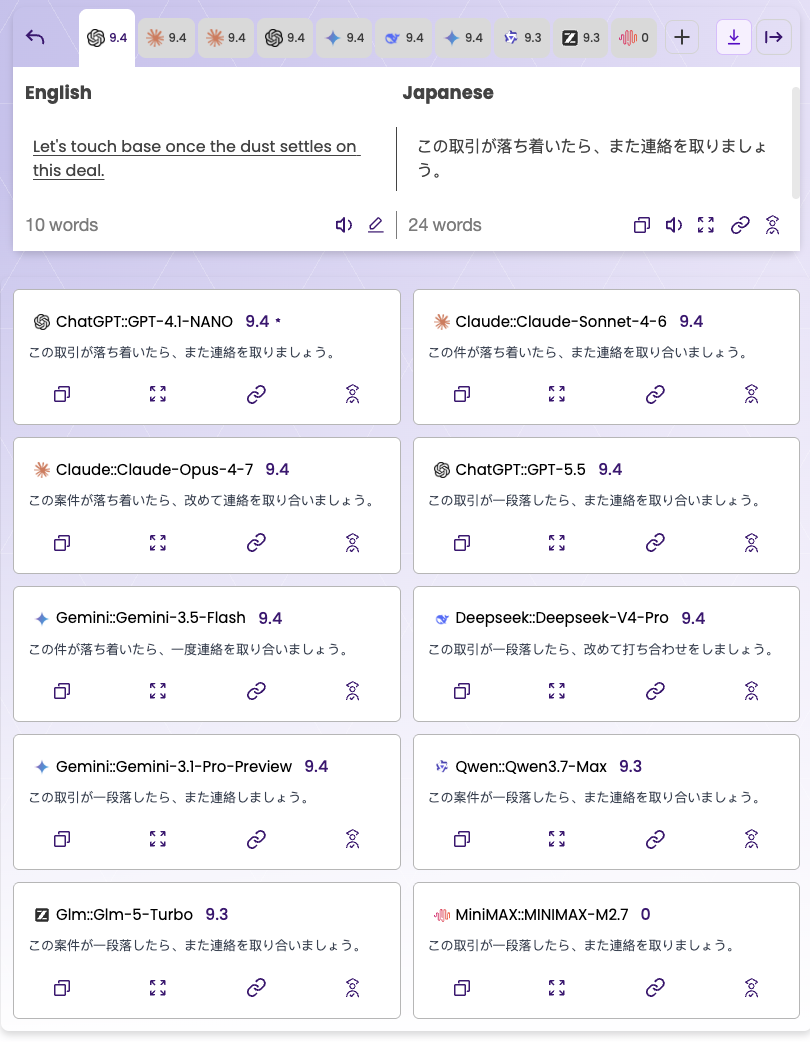
In a MachineTranslation.com model comparison test of a message to a CEO, most models answered in formal Japanese and one answered in casual plain form. The comparison view showed the difference. I look at where models split before I send anything in Japanese, because a split is the cheapest warning you will get.
| Phrase | Language | Live page |
|---|---|---|
| Sorry | French | How do you say sorry in French |
| Sorry | German | How do you say sorry in German |
| Sorry | Spanish | How do you say sorry in Spanish |
| Sorry | Japanese | How do you say sorry in Japanese |
How do you say good morning in other languages?
Spanish says “buenos días,” German says “guten Morgen,” and Arabic says “sabah al-khayr.” French speakers use “bonjour” until evening, and Korean speakers often use “annyeonghaseyo,” which works at any hour. Two of these five languages do not rely on a separate morning greeting in everyday speech.
Arabic keeps a matched pair. The reply, “sabah an-nur,” returns the greeting with a wish of light. Some phrases expect an answer, and a tool that translates only the first half gives you half of the exchange.
For French and Korean, a word-for-word “good morning” can sound like a textbook. A greeting that works all day sounds more natural, and it is the safer pick for a first message.
| Phrase | Language | Live page |
|---|---|---|
| Good morning | French | How do you say good morning in French |
| Good morning | German | How do you say good morning in German |
| Good morning | Spanish | How do you say good morning in Spanish |
| Good morning | Arabic | How do you say good morning in Arabic |
| Good morning | Korean | How do you say good morning in Korean |
How do you say best regards in other languages?
Email closings are fixed phrases, so use them as written. French uses “cordialement,” Spanish uses “saludos cordiales,” and German uses “mit freundlichen Grüßen.” Japanese business email closes with “yoroshiku onegai itashimasu.” Each language also has a more formal version for first contact or senior readers.
French offers “cordialement” for everyday business and longer formulas such as “veuillez agréer mes salutations distinguées” for formal letters. German keeps “mit freundlichen Grüßen” as the standard business closing.
Register errors in German are common enough to measure. In MachineTranslation.com’s own testing on English to German translation, about 14% of engines leaned informal when a formal business sentence used a plain “you.” A closing line is short. It is also the last thing your reader sees.
My rule for closings is simple. Pick one version per language, have a native speaker check it once, and save it as a snippet. A closing is the same in every email, so it is the cheapest line to get right.
| Phrase | Language | Live page |
|---|---|---|
| Best regards | French | Best regards in French |
| Best regards | German | Best regards in German |
| Best regards | Spanish | Best regards in Spanish |
| Best regards | Japanese | Best regards in Japanese |
How closely do AI models agree on French, Spanish, Arabic and Japanese?
Between about 84% and 87% on average for these four pairs. MachineTranslation.com measured model agreement across its ten highest-volume language pairs over three months. English to Spanish averaged 83.8%, English to French 86.0%, English to Arabic 87.3% and Japanese to English 83.6%.
Agreement did not follow how much training data a language has. English to Spanish, one of the best-resourced pairs, landed near the bottom of the ranking. English to Hindi and English to Tagalog, which have less training data, landed higher. According to the same model agreement research, the pattern tracks how ambiguous the source text is.
A single word such as “sorry” gives a model very little context. When I see a split on a short phrase, I read it as a sign that the phrase has more than one valid version.
French is where demand moved fastest recently. According to MachineTranslation.com’s analysis of the French translation volume spike, English to French volume jumped 230% in one week in June 2026. French to English and French to Arabic also entered the platform’s top 20 pairs for the first time.
For anything longer than a phrase, the same comparison runs in the English to French, English to German, English to Spanish and English to Japanese translators.
What about phrases that are not on the usual list?
Four pages cover phrases outside the usual lists: “Can I help you?” from Arabic to Tamazight, a cold-weather sentence into Inuktitut, “I’m not angry, just disappointed” into Arabic, and the wedding vow “I do” into Spanish. Open each page to see where the models agree and where they split.
The Tamazight page shows a hard failure. In MachineTranslation.com’s Arabic to Tamazight test of “Can I help you?”, Mistral AI returned the English source untranslated, while the other models produced varying Tamazight outputs.
The Arabic page shows two readings of one sentence. In an English to Arabic test of “I’m not angry, just disappointed,” one model wrote a phrase about causing disappointment in others. Another wrote a phrase about the speaker’s own disappointment. Those are two different sentences.
The wedding vow follows a convention. Spanish ceremonies usually use “sí, quiero,” which means “yes, I want” word for word. For any of these four, I would have a native speaker confirm the wording before it appears anywhere public.
| Phrase | Language pair | Live page |
|---|---|---|
| Can I help you? | Arabic to Tamazight | Can I help you, Arabic to Tamazight |
| It is very cold today | English to Inuktitut | Very cold today, English to Inuktitut |
| I’m not angry, just disappointed | English to Arabic | Not angry, just disappointed, in Arabic |
| I do (wedding vow) | English to Spanish | I do wedding vow in Spanish |
Frequently asked questions
1. How do you say please in French?
French has two versions. Use “s’il vous plaît” with a client, a stranger or anyone you address formally, and “s’il te plaît” with a friend or family member. When you are unsure, “s’il vous plaît” is the safer choice, because it works in almost every setting.
2. Does German use the same word for please and you’re welcome?
Yes, because “bitte” covers both, and the rest of the sentence shows which meaning applies. “Bitte” works with formal and informal address. For you’re welcome, Germans also say “gern geschehen” and “bitte schön.” Check the context before you translate a lone “bitte.”
3. Should I use the formal or informal version in a business message?
It depends on the reader, because each relationship sets its own level. Formal is the safer default. French “vous,” German “Sie” and Spanish “usted” signal respect, and the informal version can read as careless with a new contact. Switch to informal only after the other person does.
4. Do AI translators agree on everyday phrases?
It depends on the phrase, because agreement is high on fixed phrases and lower where a phrase has several valid versions. MachineTranslation.com measured average agreement between 83.6% and 91.9% across its ten highest-volume language pairs. Open a live phrase page to see where the models split.
5. What does sumimasen mean in Japanese?
Sumimasen means “sorry,” “excuse me” or “thank you,” depending on the moment. People use it to apologize for small things, to get someone’s attention and to thank someone for a favor. For a serious apology, “moushiwake arimasen” is the formal choice.

By William Mamane
Connect on LinkedInWilliam leads marketing and growth at Tomedes, where he turns SEO experiments and real campaign data into the strategy behind MachineTranslation.com's reach. He writes about how AI products actually get found and trusted plus the tactics that work, the ones that don't, and what search is rewarding right now.
Share:


